 arclang

Systems engineering · Arcadia · SysML v2 · Git-native
Your system architecture, as reviewable text.
ArcLang is MBSE as code: Arcadia models written in plain text, checked by a compiler that never lies, diffed by meaning, gated like flight software, and open both ways, to Capella and to SysML v2.
requirements safety {
  req "REQ-AEB-001" "Obstacle detection" {
    description: "Detect obstacles at ≥ 150 m"
    safety_level: "ASIL-D"
  }
}

architecture logical {
  component "Sensor Fusion" {
    id: "LC-001"
    function "Fuse radar and camera" { latency: 25 ms }
  }
}

trace "LC-001" satisfies "REQ-AEB-001"

$ arclang gate model.arc --standard iso26262
✓ GATE PASS — 5/5 requirements verified,
  timing budget 90 ms ≤ 100 ms, HARA consistent
01 / WHY TEXT
Diagrams you can't diff are architecture you can't review.
Graphical MBSE tools lock your architecture inside opaque databases: no pull requests, no blame, no CI. ArcLang moves the model into text — so 50 engineers can branch, review and merge a system the way they merge software — and keeps the diagrams: one per Arcadia viewpoint, generated from the model and always in sync.
Write.
Arcadia layers — operational, system, logical, physical, EPBS — in a strict, typed language:
latency: 25 msis a duration, not a string. Unknown constructs are localized errors, never silent skips:error at line 42, column 7.Verify.
The compiler resolves every trace, port and allocation. Dangling references fail the build. The production gate checks requirements coverage, HARA/ASIL consistency and timing budgets against ISO 26262 / DO-178C.
Review.
arclang diffcompares versions by stable identity: moving a block is no change, renaming is a modification — a change list of meaning, not lines.Exchange.
Round-trip with Capella (byte-identical), requirements via ReqIF to DOORS and Polarion, architecture skeletons to Simulink and System Composer, FMI 2.0 interface descriptions.
02 / ARCADIA × SYSML V2
Arcadia's method. SysML v2's expressiveness. One text.
Arcadia gives systems engineering its method: operational need, system, logical and physical architecture, each traced to the level above. SysML v2 has since given models the language they lacked. ArcLang carries both, and translates between them without losing a thing it does not tell you about.
Definitions you reuse.
A connector type gives every port its pins, an interface type every exchange its protocol, an allocation type the kinds of its ends:
trace "PN-BECU" allocates "LC-BMS" { is: "Software deployment" }is checked.One architecture, a whole product line.
Variations hold their variants, and a
configurationpicks one of each. The compiler rejects an impossible product; the diagrams draw the one you name.Views by concern.
Tag what matters,
tags: ["Safety"], and a safety view is one line that keeps itself up to date:tagged: ["Safety"].Analyses that verify requirements.
A test case asserts constraints, and its verdict is computed on every build. A requirement whose analysis fails is not verified, and the gate says so.
Ports that hold ports, buses with any number of ends.
wheel.nuts.lugNutis checked however deep;ends: [ecu.can, door.can, seat.can]is one exchange, drawn meeting at a junction.Any SysML v2 model in.
Several files, resolved against the OMG standard library; parts, connections, performed actions, messages and views become an Arcadia model that compiles. What cannot come is counted and named.
Every Arcadia model out.
To SysML v2, accepted by the OMG pilot with the same abstract syntax; back to Capella byte-identical, with what Capella cannot hold flattened and noted.
03 / VERIFIED SIMULATION
From architecture to verified simulation.
A requirement is verified when something checked it. ArcLang closes that loop for physics: the ports of the physical architecture become Modelica connectors, a test case simulates it in OpenModelica, and the verdict reaches the same gate and the same pipeline as every other check. A tool that is missing gives an inconclusive verdict, never a pass.
Architecture as code.
A port says what it carries:
physics: electrical,mechanical_rotational,thermal,signal. Connect two ports that carry different physics and the model does not compile.Modelica simulation as code.
arclang export -f modelicawrites the structure of the physical architecture, drawn, so Modex and OMEdit display it. The physics is a Modelica package you write and keep: regenerating never overwrites a line of it.A verdict, not a plot.
A test case says what to simulate and what must hold:
min("PN-BATT".soc) >= 0.1.arclang verifyruns OpenModelica, locally or in Docker, and checks the units. In the electric-vehicle example, at −10 °C and 100 km/h, the 82 kWh pack ends the 300 km trip with 28.7 % of its charge and the 64 kWh pack with 8.7 %.The gate.
A failing simulation is a blocker. A verdict that is missing or stale counts as not verified, and the gate says which command to run. The verdict is cached under a key of the model and the Modelica sources.
CI.
The same commands run in GitHub Actions, GitLab CI, Azure DevOps or Jenkins, and the pull request gets one comment that says what the change does to the model.
A requirement that fails, found before the road
Both packs drive the 300 km. Only the evidence differs, and it is in the build: the standard pack ends at 8.7 %, under the 10 % reserve, so the requirement is not verified and the gate fails. This output, abridged, is the one the documentation shows, run against OpenModelica 1.27.1.
$ arclang verify ev_range_simulation.arc
✗ TC-RANGE-STD "Winter range, standard pack": FAIL
    FAIL min(batteryPack.soc) = 0.08693
✓ TC-RANGE-LR "Winter range, long range pack": PASS
    ok   min(batteryPack.soc) = 0.2874
$ arclang gate ev_range_simulation.arc
✗ [requirements.verification] REQ-RANGE:
    verification cases fail
PRODUCTION GATE: FAIL ✗ (1 blockers)
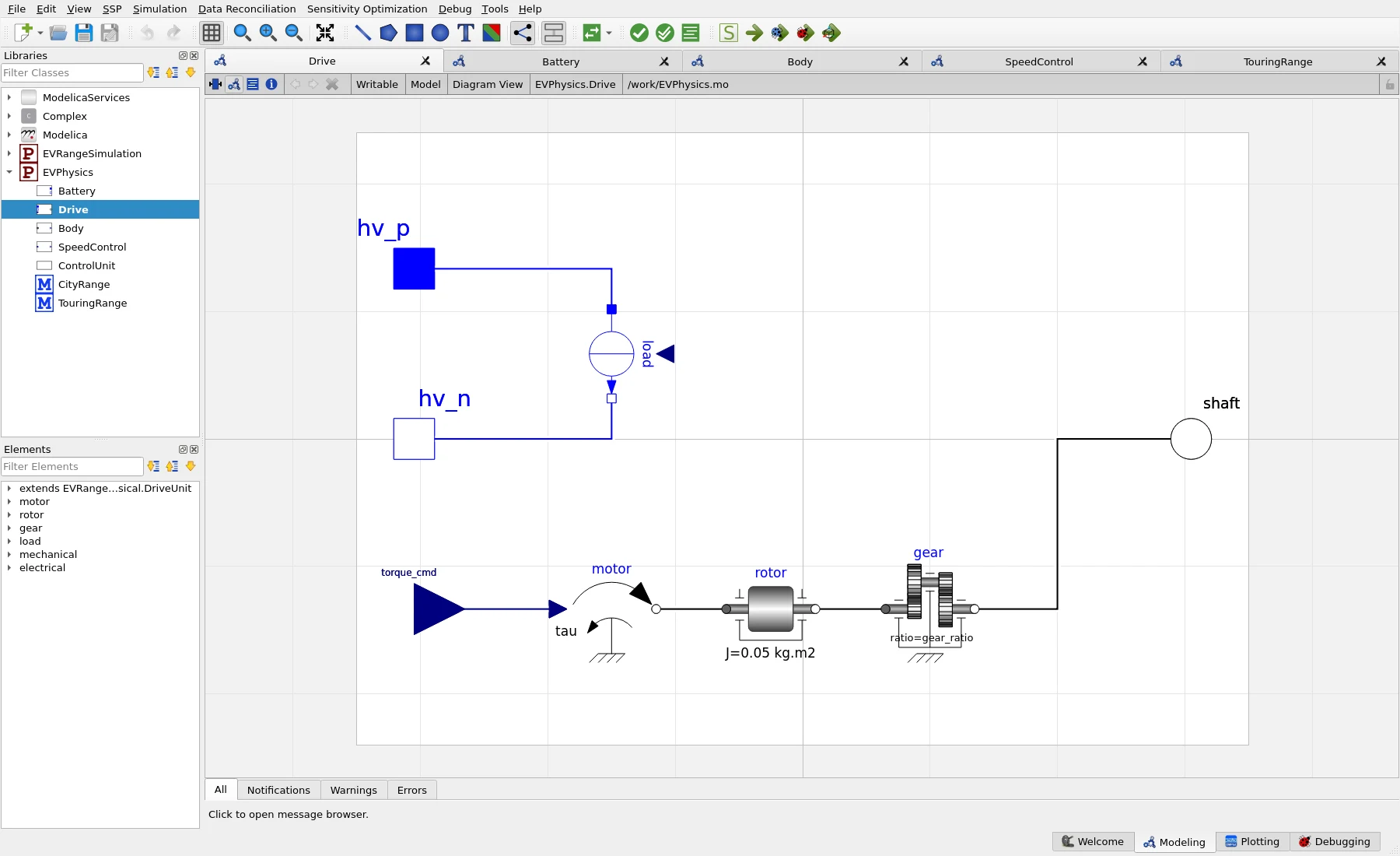
The drive unit in OMEdit (OpenModelica 1.27.1): Modelica Standard Library motor, inertia and gear, wired to the connectors ArcLang generates from the physical architecture.
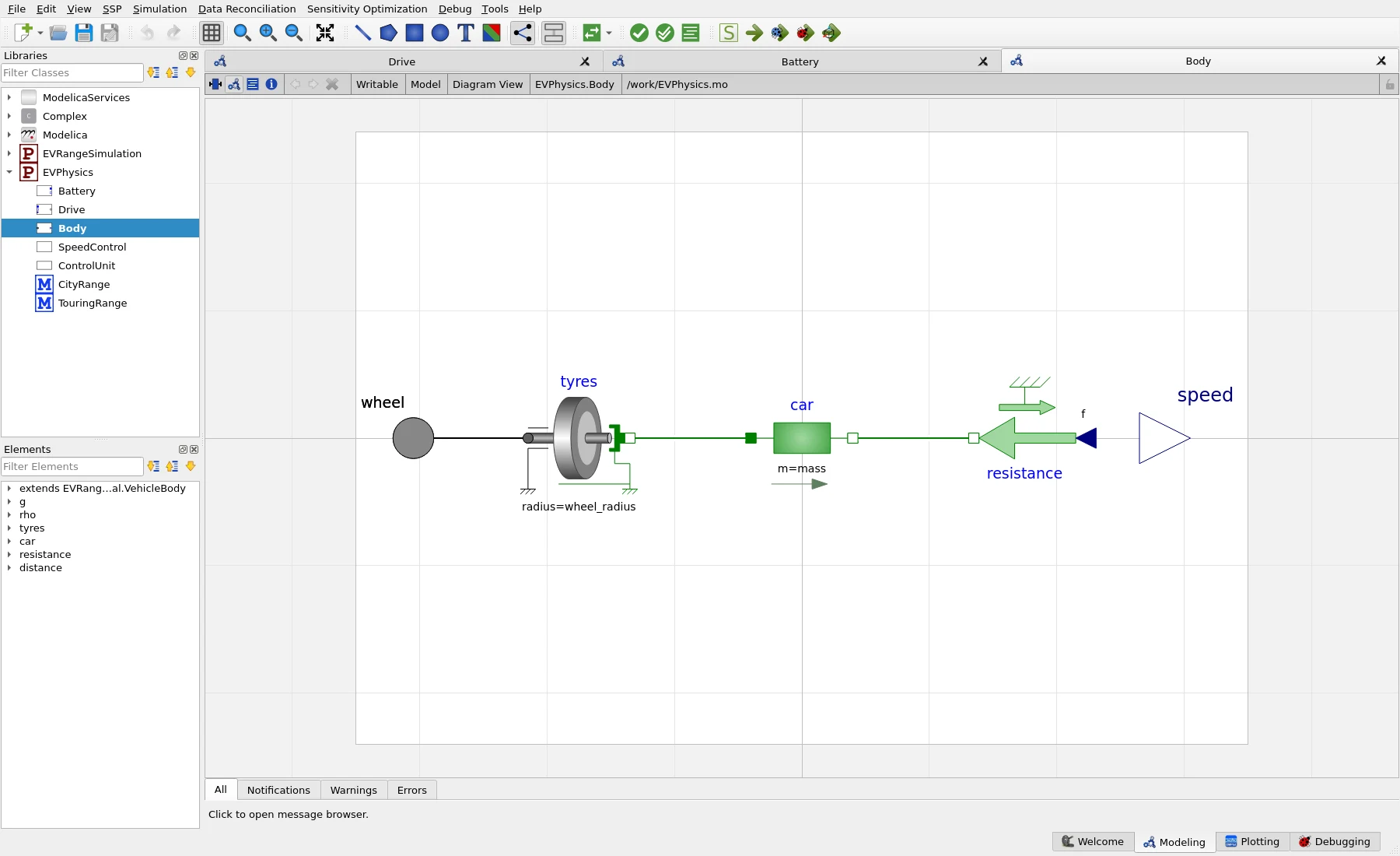
The vehicle body: wheel, mass and drag force. The physics is a Modelica package you write and keep; regenerating the structure never overwrites it.
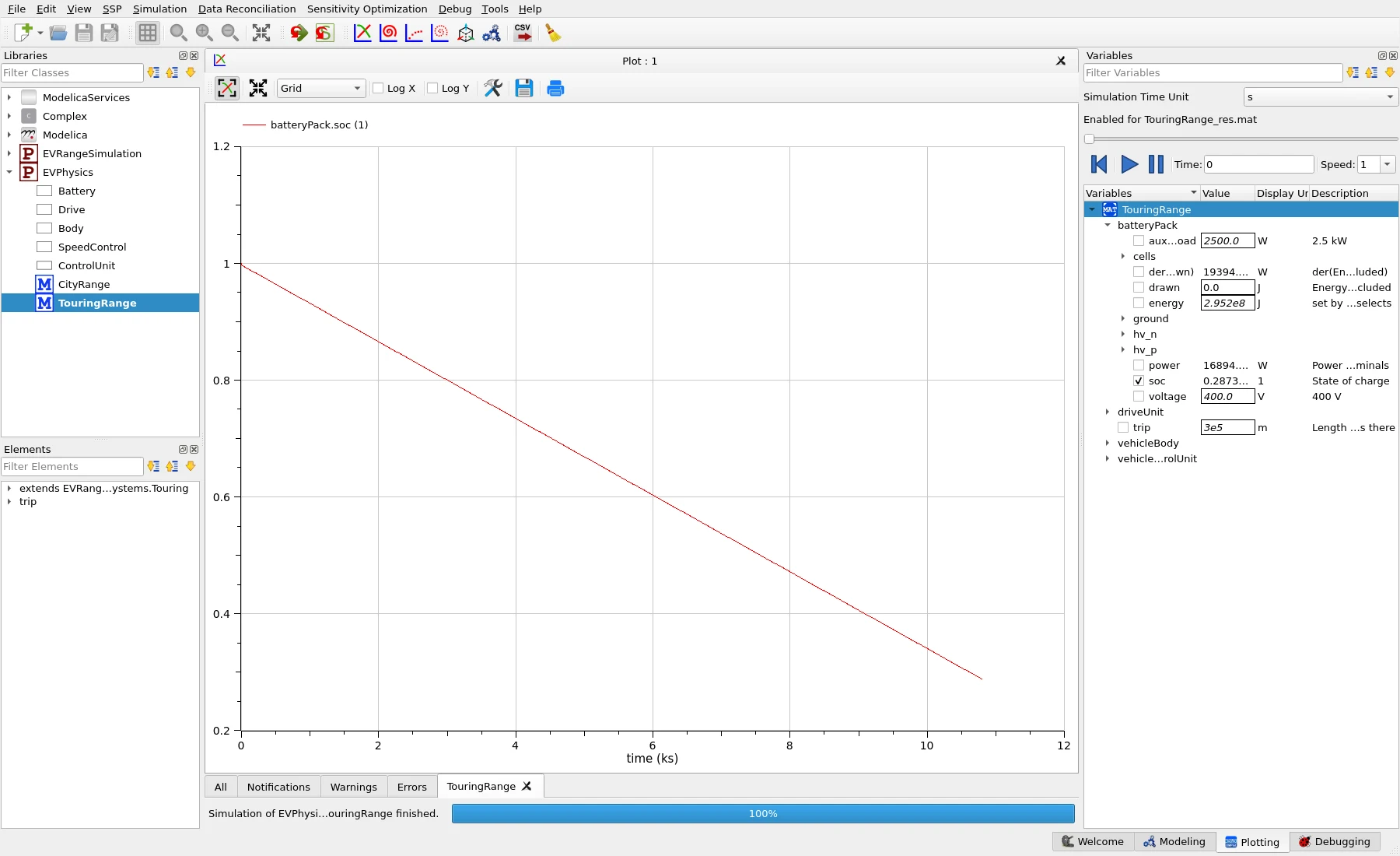
The same model simulated in OMEdit: the long range pack ends the 300 km at 28.7 %, the value arclang verify checks against the 10 % reserve.
How likely the requirement holds, not whether it held once
Cars meet cold mornings and fast drivers. Give a test case its uncertain parameters and ArcLang draws them as a Latin hypercube, runs every sample in OpenModelica, and passes the case only when the probability that the requirement holds is shown to reach the one required, at the confidence you ask. The gate takes that verdict. R or Python read the same samples for the statistics an engineer wants next.
$ arclang verify ev_range_simulation.arc
✓ TC-RANGE-LR "Winter range, long range pack": PASS
    Monte Carlo: 40 samples, 40 hold
    probability between 92.78 % and 100 % at 95 % confidence
    what moves the charge left:
        -0.88  speedController.target_speed
        +0.50  vehicleBody.ambient
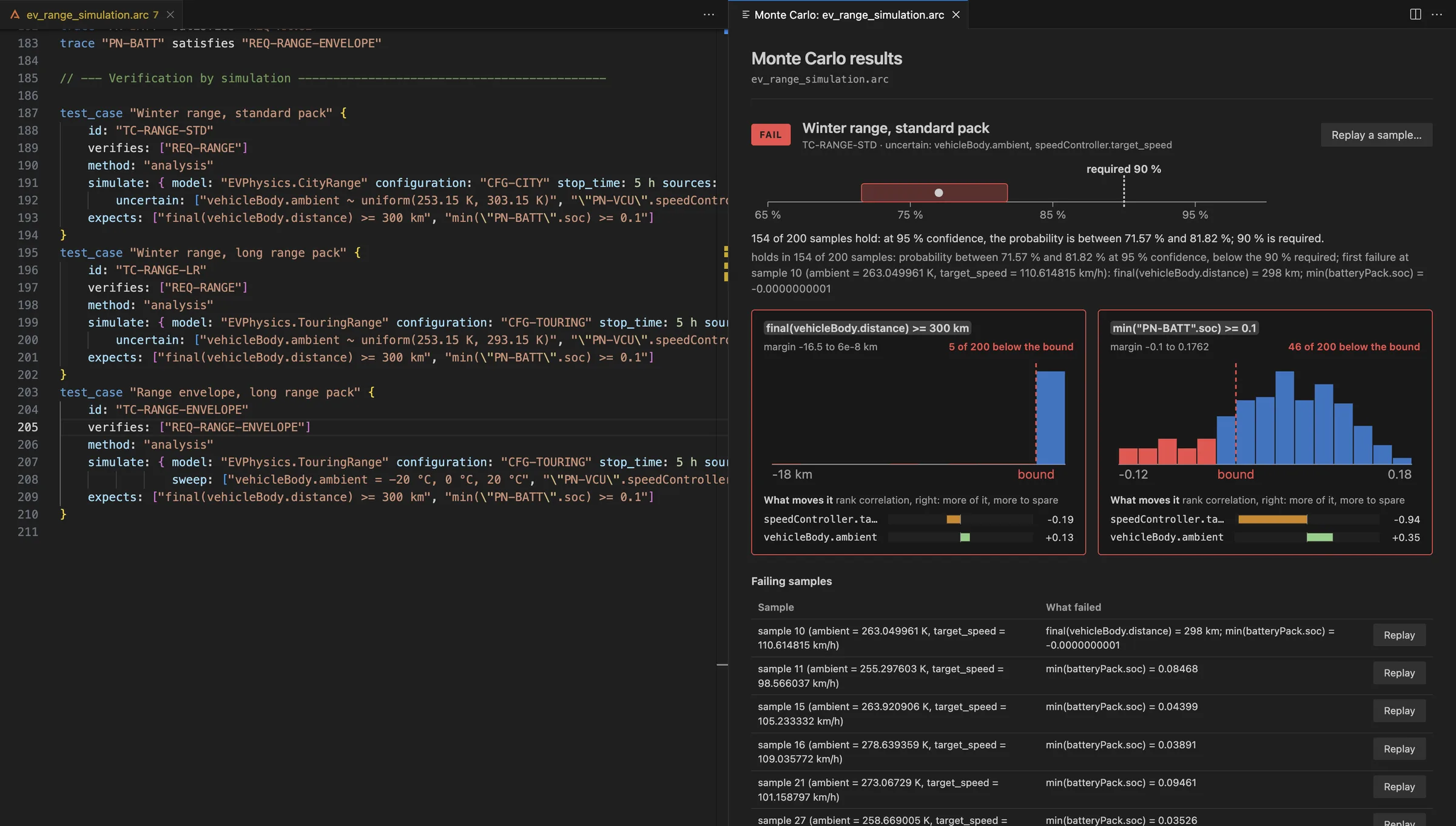
In VS Code, the test case and its results side by side: 200 OpenModelica runs of the standard pack, from −20 to 30 °C and 75 to 115 km/h. 154 hold, so the probability lies between 71.6 % and 81.8 %, below the 90 % required: the requirement is not verified. The cruising speed drives the charge left (−0.94).
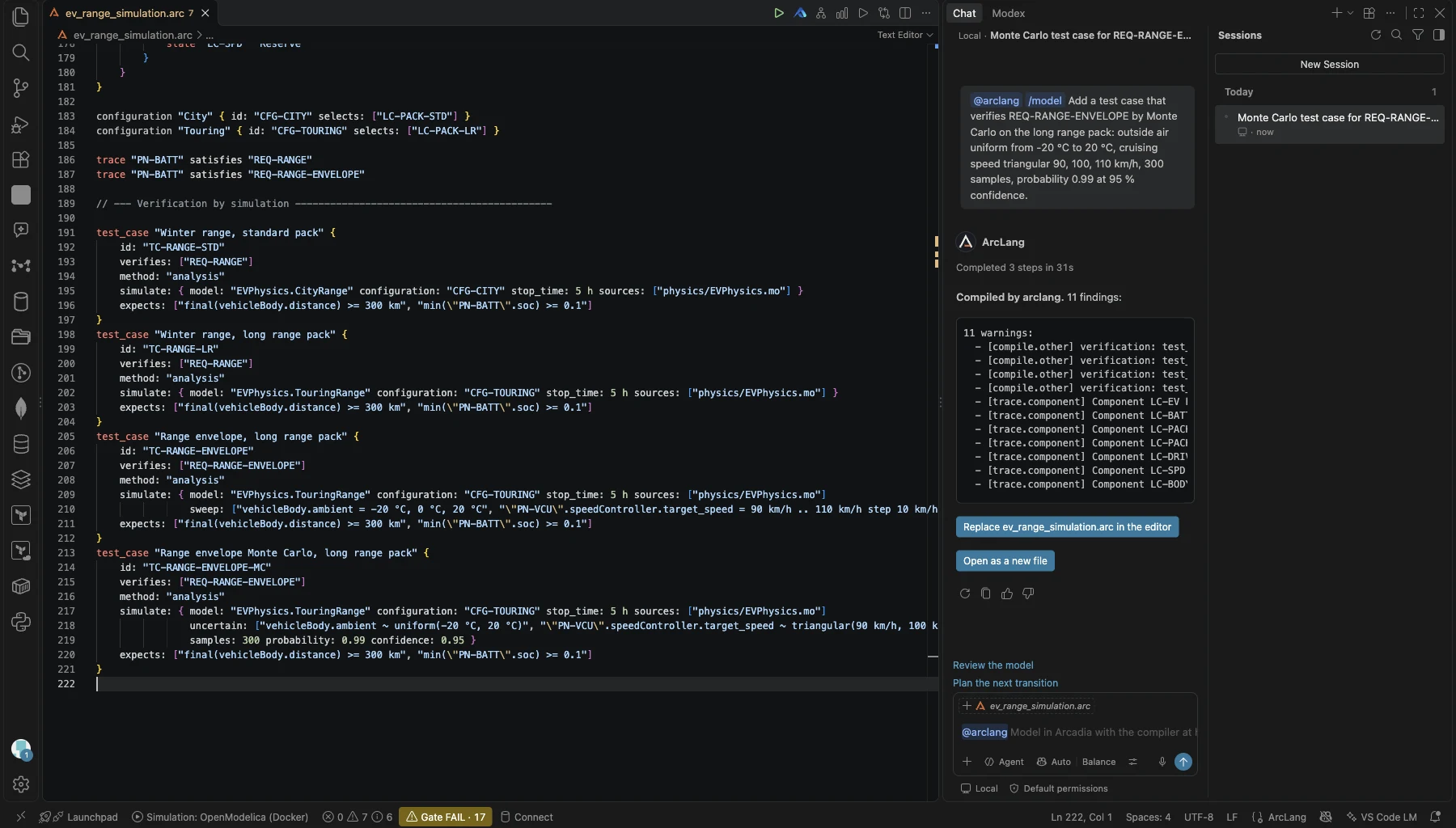
@arclang in GitHub Copilot Chat writes the Monte Carlo case from one sentence: two laws, 300 samples, 0.99 at 95 % confidence. The compiler checks it before it is shown; one click puts it in the model.
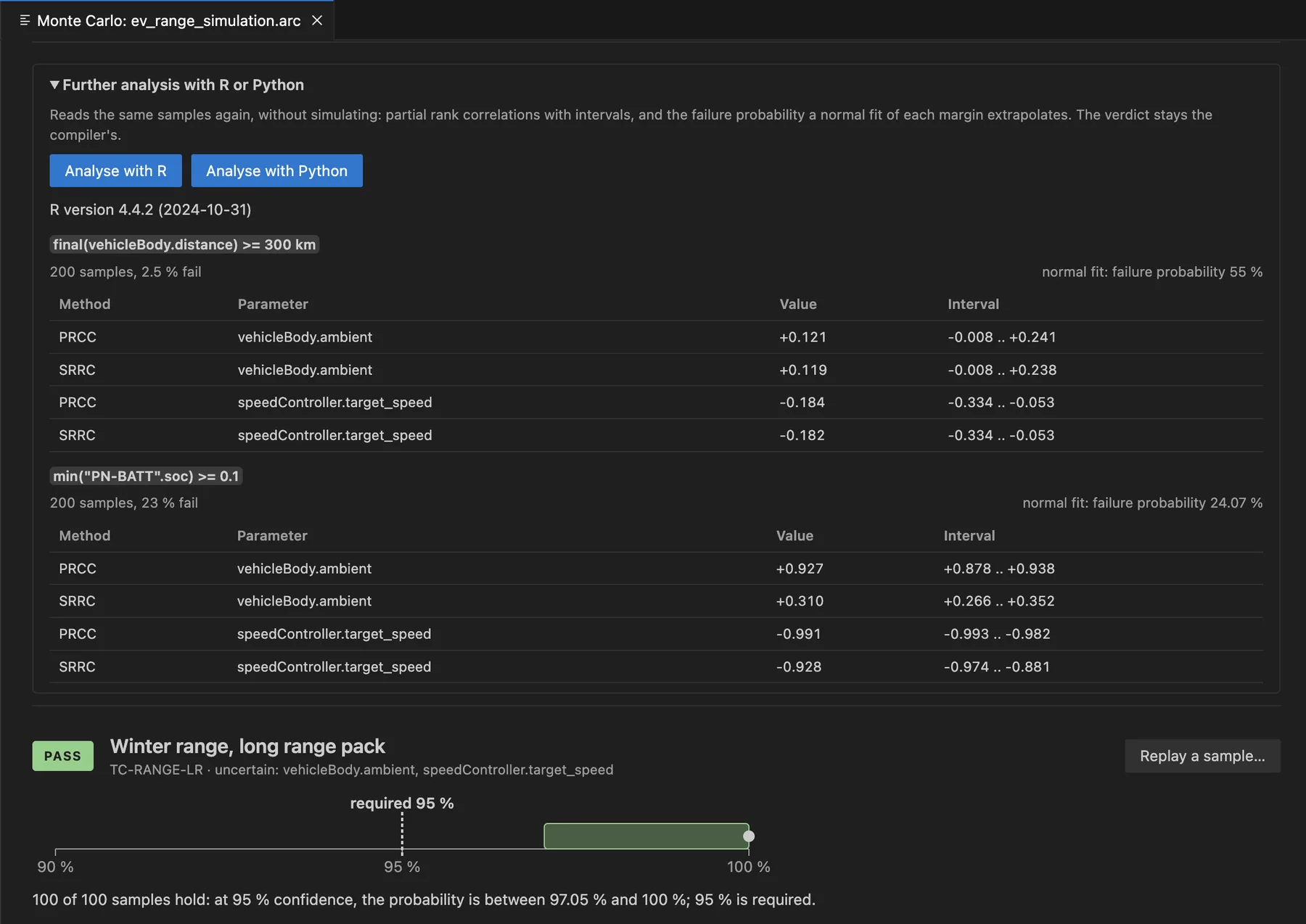
R reads the same 200 samples without simulating again: partial rank correlations and standardized rank regression with bootstrap intervals, in base R.
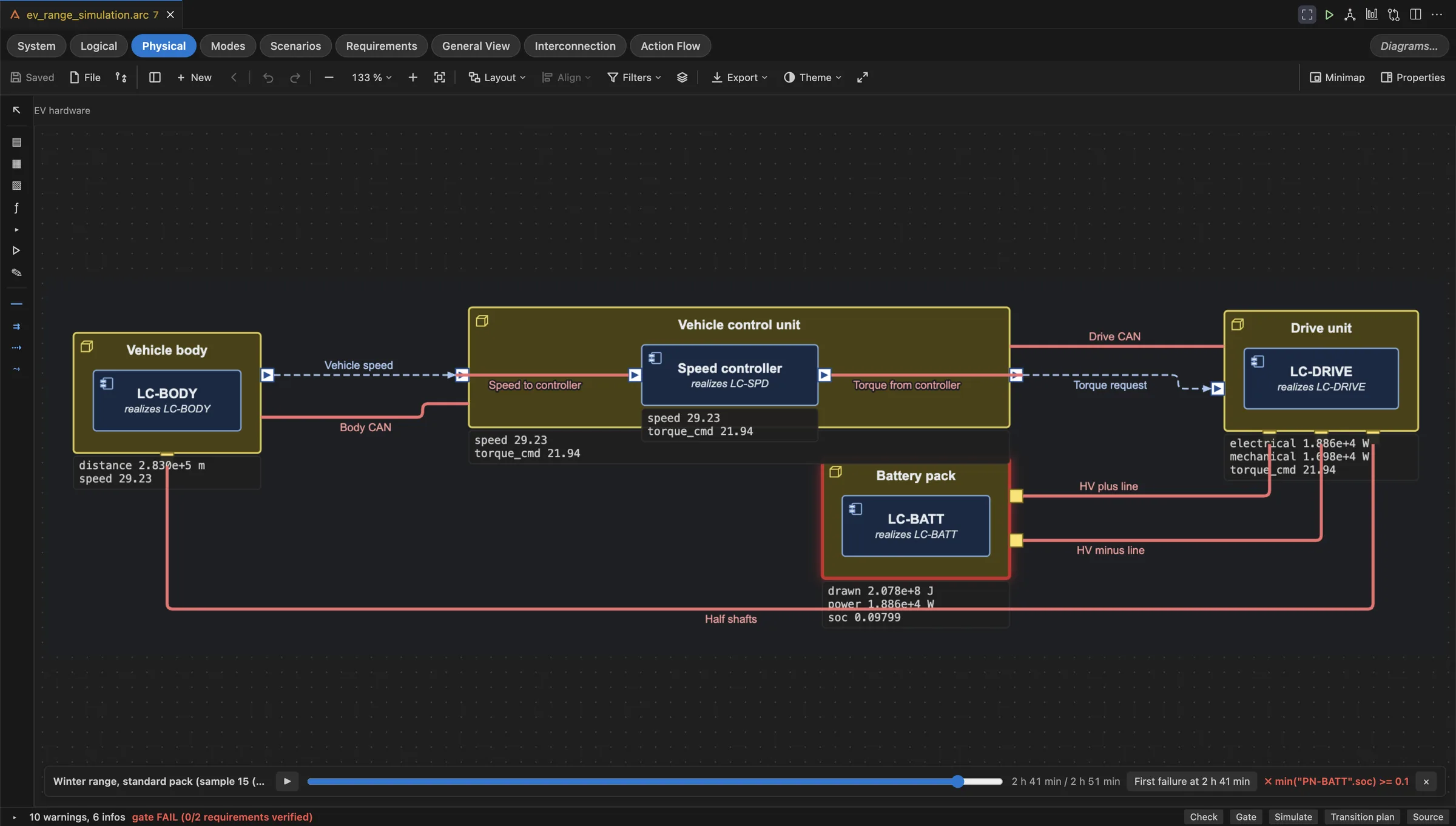
A failing sample replayed on the diagram: the battery pack outlined in red at the instant its charge falls below 10 %.
04 / CAPABILITIES
Everything a systems team ships with — verified in CI, not promised.
A compiler that never lies
Strict parsing with source positions, deterministic element identity (UUIDv5 — same id, same UUID, everywhere, forever), and semantic analysis that treats a dangling trace as a build failure. If it compiles, the traceability graph is real.
# identity is frozen by golden-value tests
LC-001 → 8006ab91-390c-5908-8464-b353219dfc1f
# …and cross-checked against an independent
# implementation, on every commit
Diagrams you navigate, not redraw
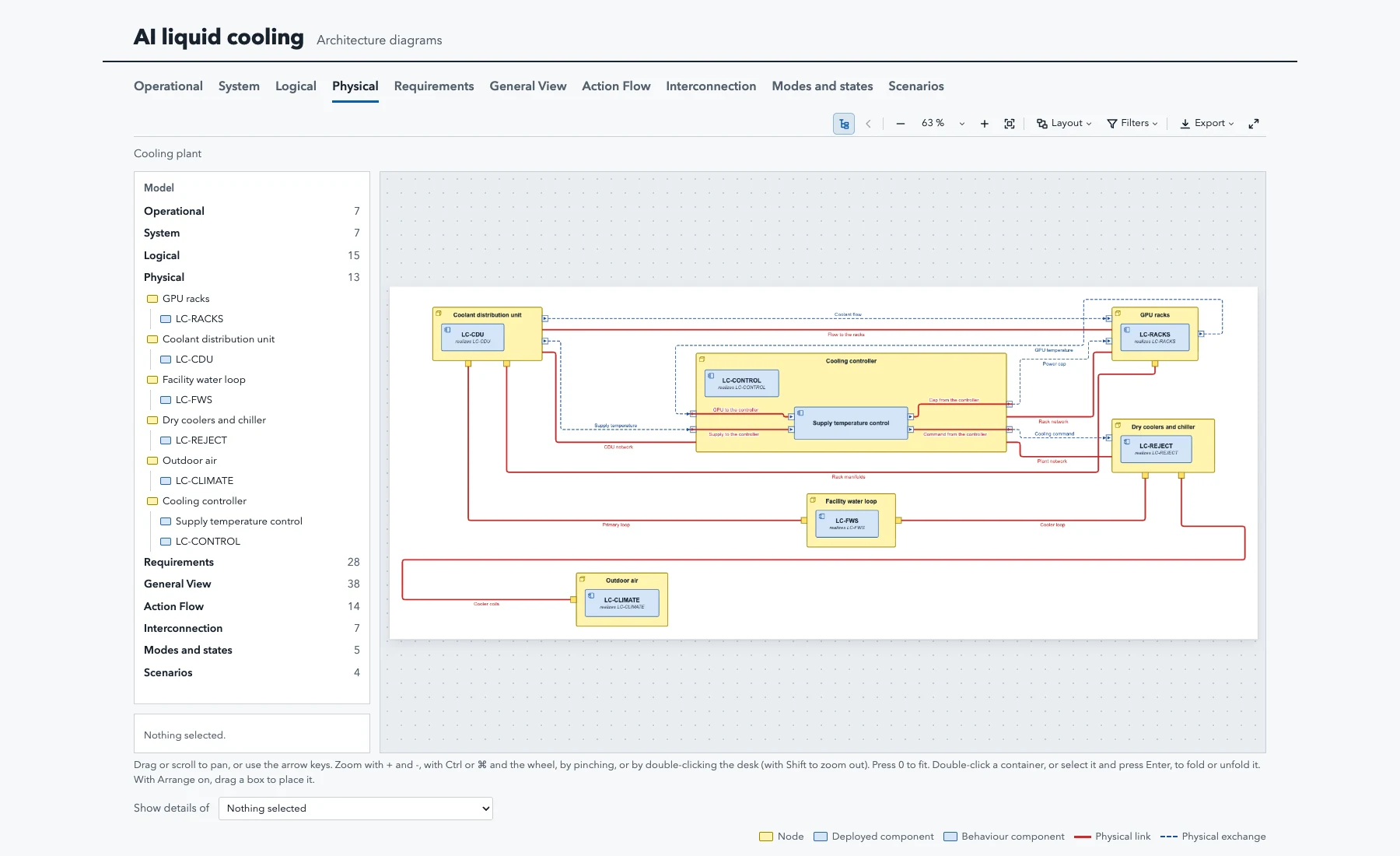
The compiler draws one diagram per Arcadia viewpoint: operational, system, logical and physical architecture with functions inside their components and exchanges on their ports, plus capabilities, data, modes and states, scenarios and the product breakdown. Follow an element across layers to what it realizes, fold a container or open it as a diagram of its own, arrange blocks by hand. The arrangement is a file next to the model, so it is versioned and reviewed with it.
$ arclang diagram aeb.arc -f html -o aeb.html
✓ 9 kinds of view · one self-contained file
# Across layers
"SensorFusion"  satisfies    "REQ-AEB-002"
"SensorFusion"  realized by  "FusionModule"
# aeb.layout.json — folds and placement, in Git
Capella round-trip
Import native Capella models (184 elements matched on the reference project), edit as text, sync back by UUID — the XML comes back byte-identical when nothing changed.
Production gate
One command answers "can we release this design?": requirement satisfaction and verification, ASIL recomputed from S/E/C, timing budgets summed along functional chains, ICD completeness.
ReqIF exchange
OMG ReqIF import/export for the DOORS / Polarion loop: text, hierarchy and relations read, foreign identifiers kept on the way back.
Simulink & FMI
System Composer architecture scripts, hierarchy and Stateflow included, and FMI 2.0 interface descriptions validated against the standard, GUIDs that change only with the interface.
SysML v2, both ways
Imports any SysML v2 model, in one file or many, against the OMG standard library: connections, allocations, sequences and views. Exports every model, checked element by element against the OMG pilot. Open the Simple Vehicle Model of the specification.
Multi-file models
import "subsystem.arc" — each team owns its fragment, the compiler assembles and cross-checks the whole. Circular imports and identity collisions are caught.
Semantic diff
Model review as a change list of identities. CI-gateable: exit 1 on unreviewed model change.
A typed metamodel
Quantities carry their unit and dimension, so a latency compared to a bandwidth is caught. Enumerations, multiplicities, constraint assertions and your own types with specialization. The metamodel document is generated from the compiler, and a test fails when the two disagree.
Systems Modeling API
arclang serve exposes the model, element by element, with one API commit per Git commit and a diff by identity. Writes are opt-in, token-protected, and land as Git commits that keep your comments.
Cybersecurity analysis
Primary assets, threats and their scales, at the level they belong to, as Capella's security viewpoint has them. They go to Capella and to SysML v2 and come back whole.
A workbench in VS Code
The model text on one side, its diagrams, tree and properties on the other, the same compiler behind both. Click or type: the file is the same, and an AI agent edits it through the compiler.
Semantic git: review and merge a model, not its lines
Compare a model with any revision by element identity, and the report carries what the change does: the gate before and after, the budget it breaks. Every element has a history. A merge driver merges two branches that touched different attributes of the same line, and marks a real conflict around the element. A baseline binds the gate verdict, the coverage and the exports to a git tag that an auditor can verify.
$ arclang diff brake.arc --from HEAD
~ modified SystemFunction 'Detect obstacle'
    latency: "40 ms" -> "80 ms"
Production gate: PASS -> FAIL
  + blocker: functional_chain 'Detection to braking':
    sum of function latencies 130.0 ms
    exceeds the 100.0 ms budget
$ arclang baseline verify v1.0
Baseline 'v1.0': VERIFIED
Branches, snapshots, merges and time travel
A bar along the workbench walks the model's history: each commit drawn as it was, the snapshots as flags, the merges as diamonds, and what changed since any earlier moment marked on the diagram. Restore one element or the whole model from the past as an edit you review; history is never rewritten. Branches merge by element: only an element changed differently on both sides needs a decision.
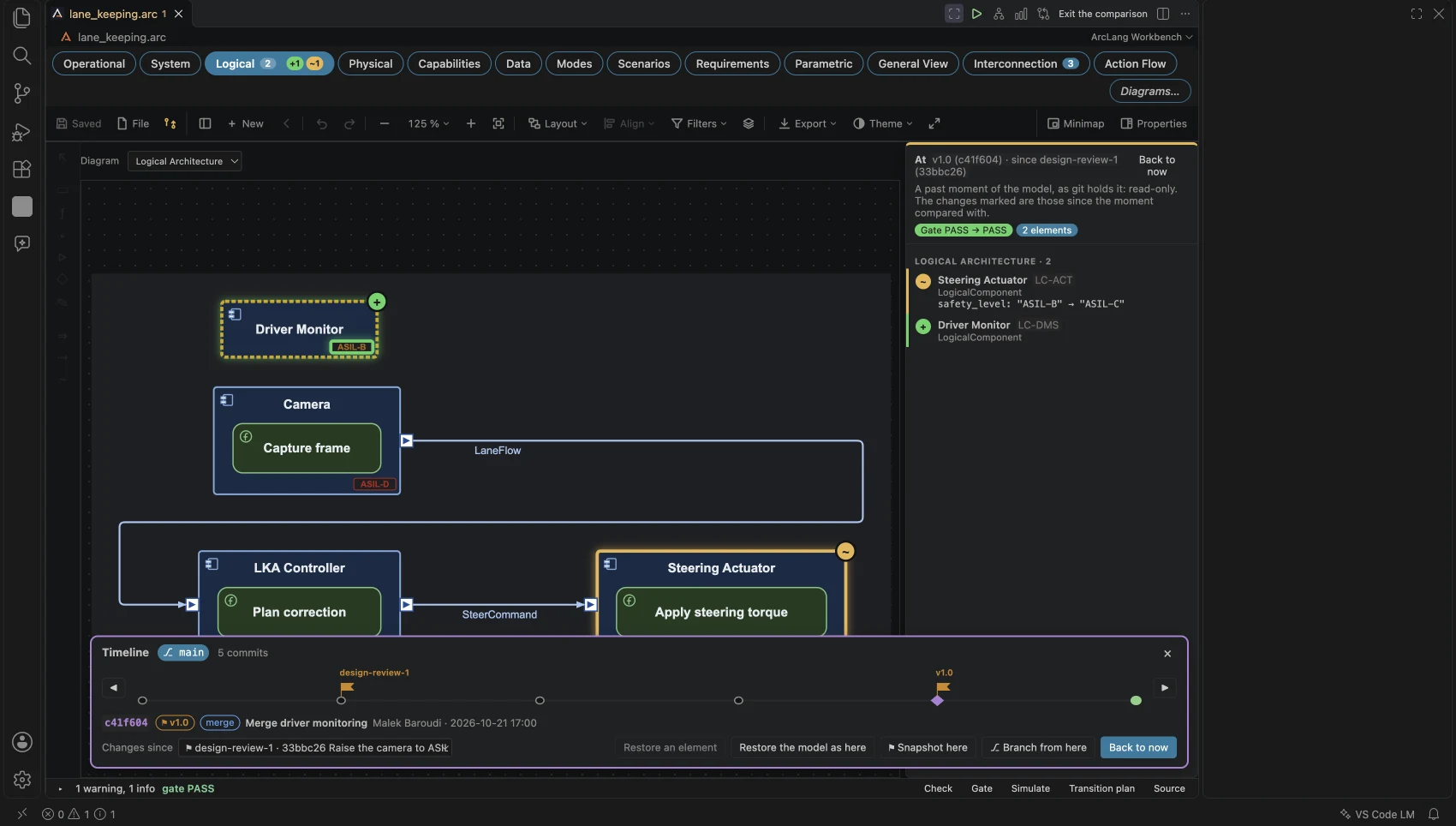
The model at v1.0, compared with the snapshot design-review-1: the driver monitor added since in green, the actuator raised from ASIL-B to ASIL-C in amber.
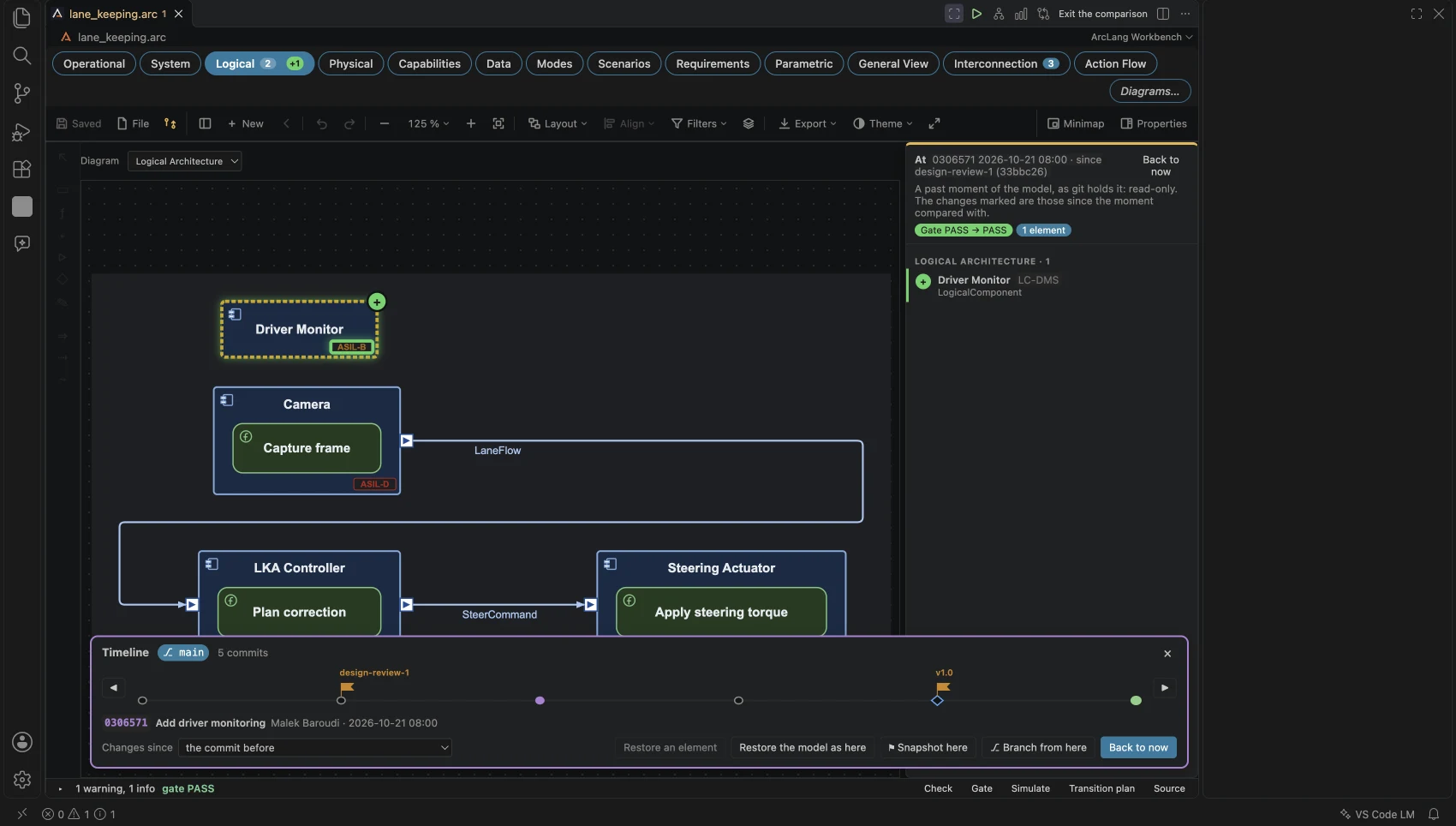
One commit back: the model as it was when the driver monitor was added.
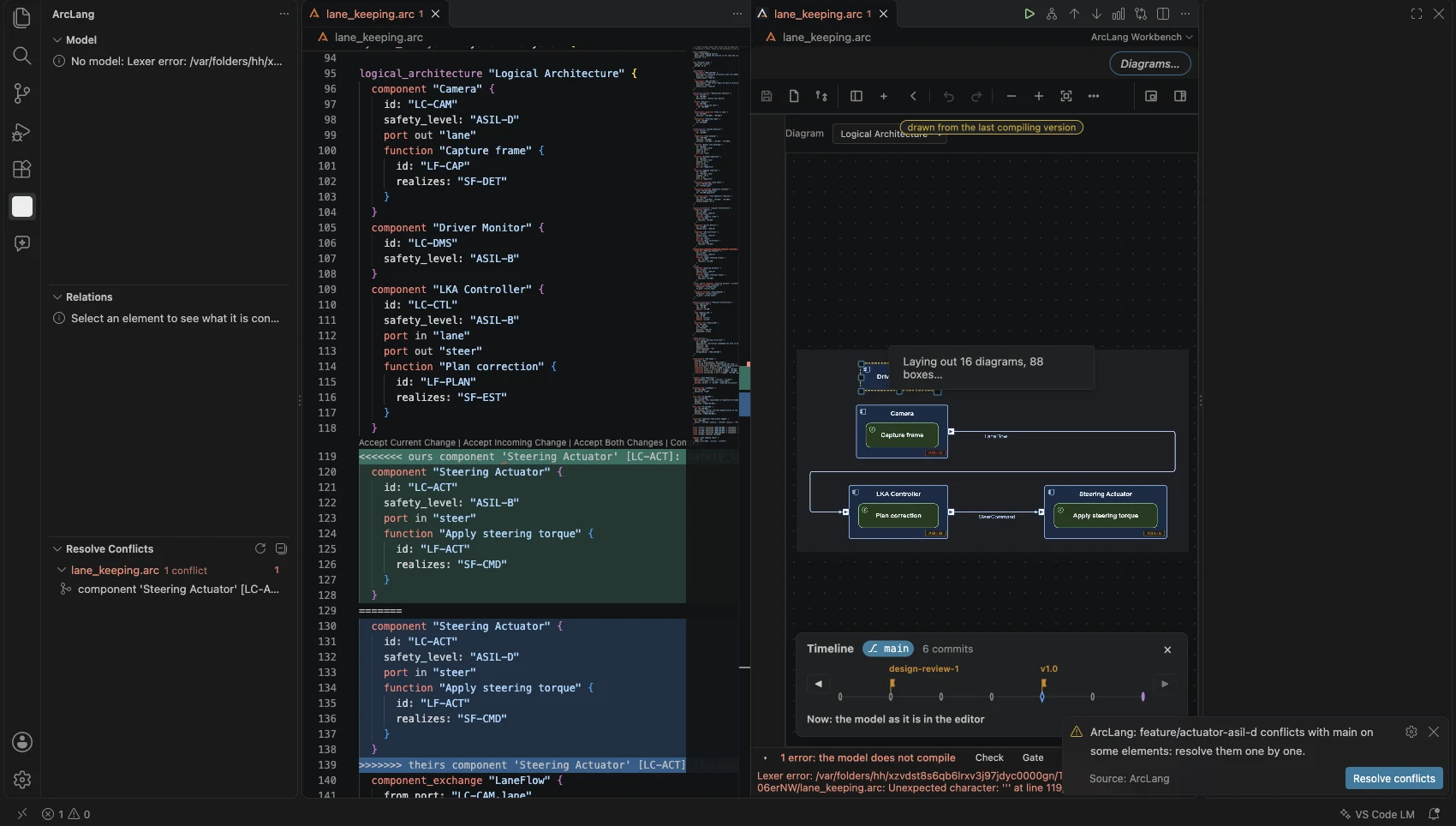
A merge where both branches changed the actuator: that element alone is in dispute, each side whole.
The gate in your pipeline
arclang ci init writes the pipeline for GitHub Actions, GitLab CI, Azure DevOps or Jenkins; the check named ArcLang gate can be required on the default branch. SARIF 2.1.0 goes to code scanning, and a pull request gets one comment, updated on each push. The generated files are tested as files; the first run on your provider is their test, and the documentation says so.
Impact analysis, and the what-if before the edit
What a change reaches, by link and by distance, with the path that explains it. arclang impact --change applies a proposed edit to a copy, compiles it, and says what it would break before you touch the model. In VS Code the same analysis is a live tab, with Apply as one undo.
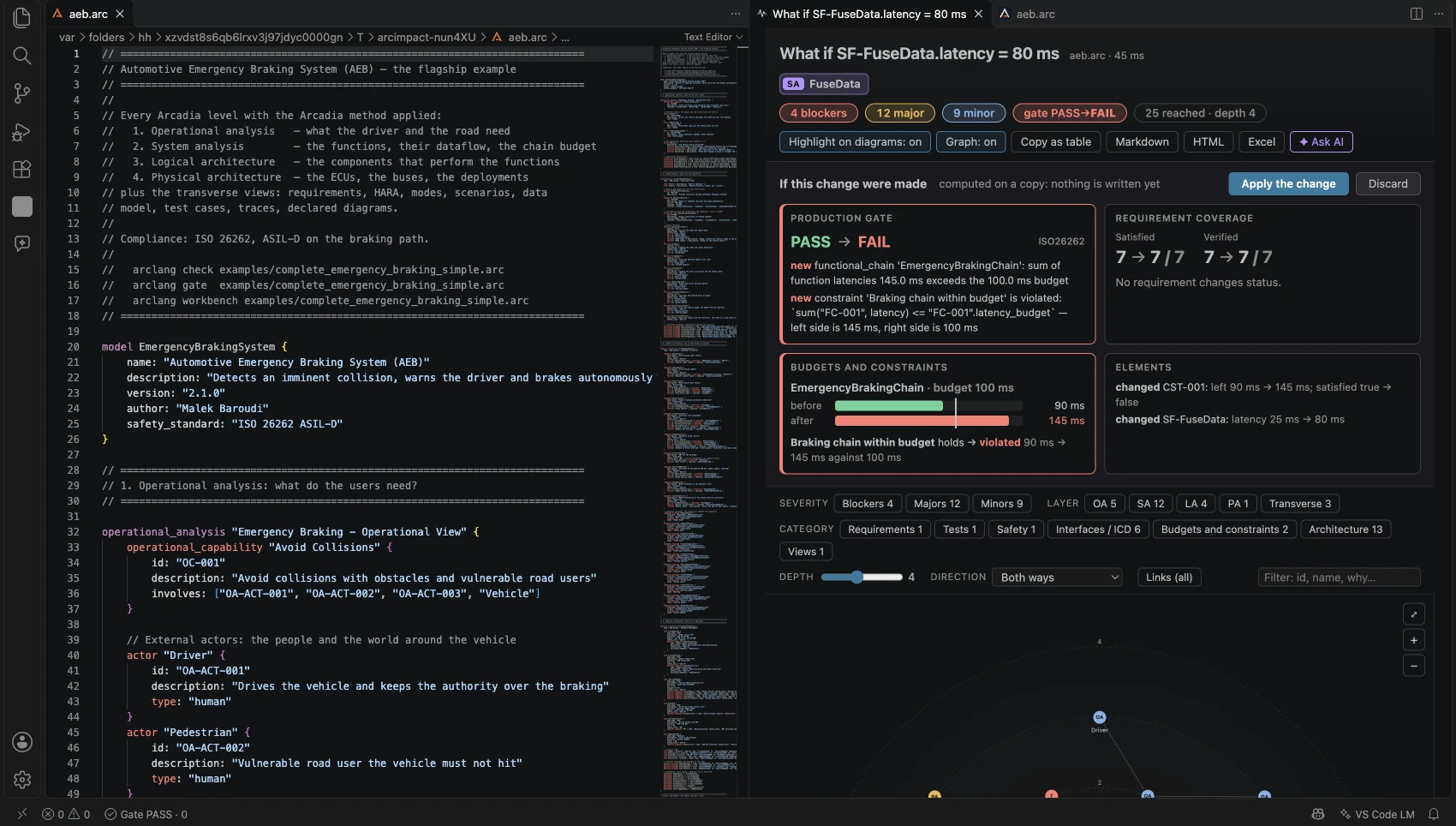
What if the sensor fusion took 80 ms? Computed on a copy before anything is written: the gate goes from PASS to FAIL, the braking chain needs 145 ms against its 100 ms budget. Apply the change writes it as one undo; Discard leaves the model untouched.
Live tables and matrices
Requirement coverage with the verdict of each test case, traceability, allocation, N² interfaces and the ICD, computed by the compiler. Edit a cell and the model changes; export CSV or Excel, or paste into PowerPoint.
An AI you choose, a compiler that decides
Eight providers, from VS Code's own models to Anthropic, OpenAI, Mistral, Google, Azure, a local Ollama or any compatible server. Every proposal is compiled on a copy first, and Apply is one undo. Off sends nothing.
An architecture studio in your pocket
On a phone, the playground becomes an AI design studio: describe a system — or photograph a whiteboard — and read the compiled architecture dossier on the spot. The same verified compiler, anywhere. Try that with a desktop MBSE suite.
you> 📎 whiteboard.jpg — "model this"
ai>  6 components, 4 requirements, deployed
✓ compiled — GATE PASS · dossier ready to share
# from the back of a taxi
From architecture to first commit
The model becomes code you can build on — contracts only, never invented behavior. Deterministic exports ship C99 headers that compile clean and Protobuf that turns into Java, C++, Python, Go or TypeScript via protoc. And the AI assistant reads your stack: an FPGA node gets VHDL entities, CAN links get C plus a DBC sketch, a JVM service gets gRPC interfaces — proposed in context, generated on demand, downloaded in one tap.
# the assistant reads your architecture
node "SignalFPGA"   → "Want the VHDL entities?"
link protocol: CAN  → "C headers + DBC matrix?"
node "OrderService" → "gRPC + Java interfaces?"
⬇ interfaces.vhd · interfaces.h · interfaces.proto
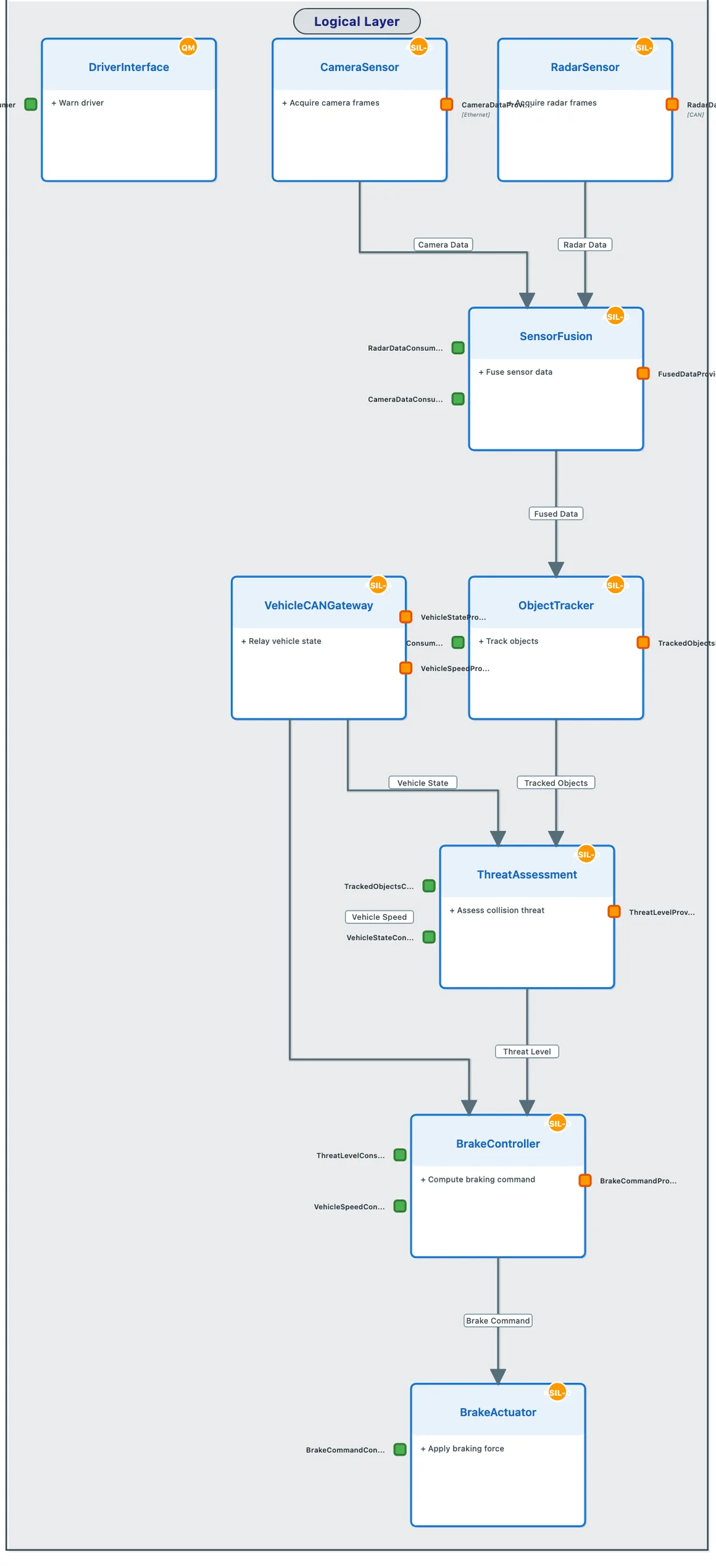
The logical architecture of the AEB reference model, drawn by the compiler: functions inside their components, exchanges on their ports, ASIL badges. Sensor Fusion is selected, with what it satisfies and what realizes it one layer down. Click through to compile it yourself.
05 / TRUST
Built to be depended on for thirty years.
Aerospace and automotive programs outlive tools. ArcLang's governance is designed for that timescale.
Qualification-ready
A tool-qualification support kit ships in the repository: ISO 26262-8 §11 TCL analysis, DO-330 TQL determination, function/malfunction inventory, and an evidence matrix into the actual test suite.
Verifiable supply chain
MIT-licensed. RustSec dependency audit on every commit. Releases ship binaries with SHA256SUMS and GitHub build-provenance attestations.
Stability guaranteed
The language is semver'd and a major version ships with its migration note, identity derivation is frozen by golden tests, and every output is deterministic: a diff always means a change, never noise.
06 / OFFER
Free where it spreads. Paid where it matters.
Open source — forever
The language, the compiler, the CLI, the gate and this playground. Attested releases, qualification support kit in the repo. No lock-in is the feature: your models are text files you own.
Team workspace
Hosted model review with visual semantic diff, gate dashboards per program, ReqIF exchange flows, SSO. Built for suppliers and design offices.
Get early access →Enterprise, air-gapped
On-premise deployment, long-term support, tool-qualification assistance (ISO 26262-8 / DO-330), Capella migration services and training. Advanced interface generators on the enterprise roadmap: AUTOSAR ARXML, DDS IDL, Ada/SPARK specs, CAN DBC matrices.
Talk to us →AI-native by design
The playground ships an AI design assistant: describe your system, the model writes ArcLang, the compiler verifies it — the loop runs until the gate passes. And because ArcLang is text with a strict compiler, it's what makes AI-assisted systems engineering safe: the AI proposes, the compiler never lies. An MCP server ships in the repository for Claude and other assistants.
you> design a battery management system, ASIL-C
ai>  writing model… 4 components, 6 requirements
✓ compiled in 3 ms — GATE PASS (6/6 verified)
07 / TRY IT
The full compiler runs in your browser. Your model never leaves it.
The playground is the real ArcLang compiler — the same Rust core as the CLI — compiled to WebAssembly. Compilation, validation, the safety gate and the architecture explorer all execute client-side. Nothing is uploaded, ever. Paste a confidential model with a clear conscience. And it works on your phone: sketch, describe, review — the full toolchain fits in your pocket.