 arclang
Co-simulation in OMSimulator: FMUs and SSP
arclang cosim runs a model's executed test cases as a standard FMI co-simulation, in OMSimulator, OpenModelica's FMI and SSP master, and judges the run as arclang sil judges the C: the case's expects: on it, and its trace step by step against the model.
arclang cosim model.arc                    every case that execute:s
arclang cosim model.arc --test TC-CHG-HIL  one case
arclang cosim model.arc --keep build/cosim the SSP, the result and the logs kept
arclang cosim model.arc --json             the outcomes as JSON
The point is that the behavior now runs as an FMU, under a master that is not ArcLang's. The machine is exported as an FMI 2.0 co-simulation FMU (export -f fmu), its plant as another FMU (OpenModelica's, or the one the case gives, from Simulink, Dymola, Amesim…), and the two are connected in an SSP package (System Structure and Parameterization 1.0) that any SSP tool opens. What ArcLang proves on its own loop is then proven again on the standard exchange.
Tutorial: a charger and its battery in OMSimulator
About fifteen minutes. You need ArcLang Studio, which holds the compiler, OpenModelica and OMSimulator, or a computer with all three. The model is examples/energy/battery-charger of the repository: the charge controller of a 48 V battery, written as a state machine (precharge, bulk, absorption, a PID on the current, a voltage filter), and its battery written in Modelica (physics/ChargerPhysics.mo).
1. Open the example. In Studio, open the folder examples/energy/battery-charger and battery_charger.arc. Go to the test case TC-CHG-HIL. Its plant: block says what is connected to what: the controller's setpoint drives the battery's i_set, and the battery's v_batt and i_batt come back as the controller's voltage and current.
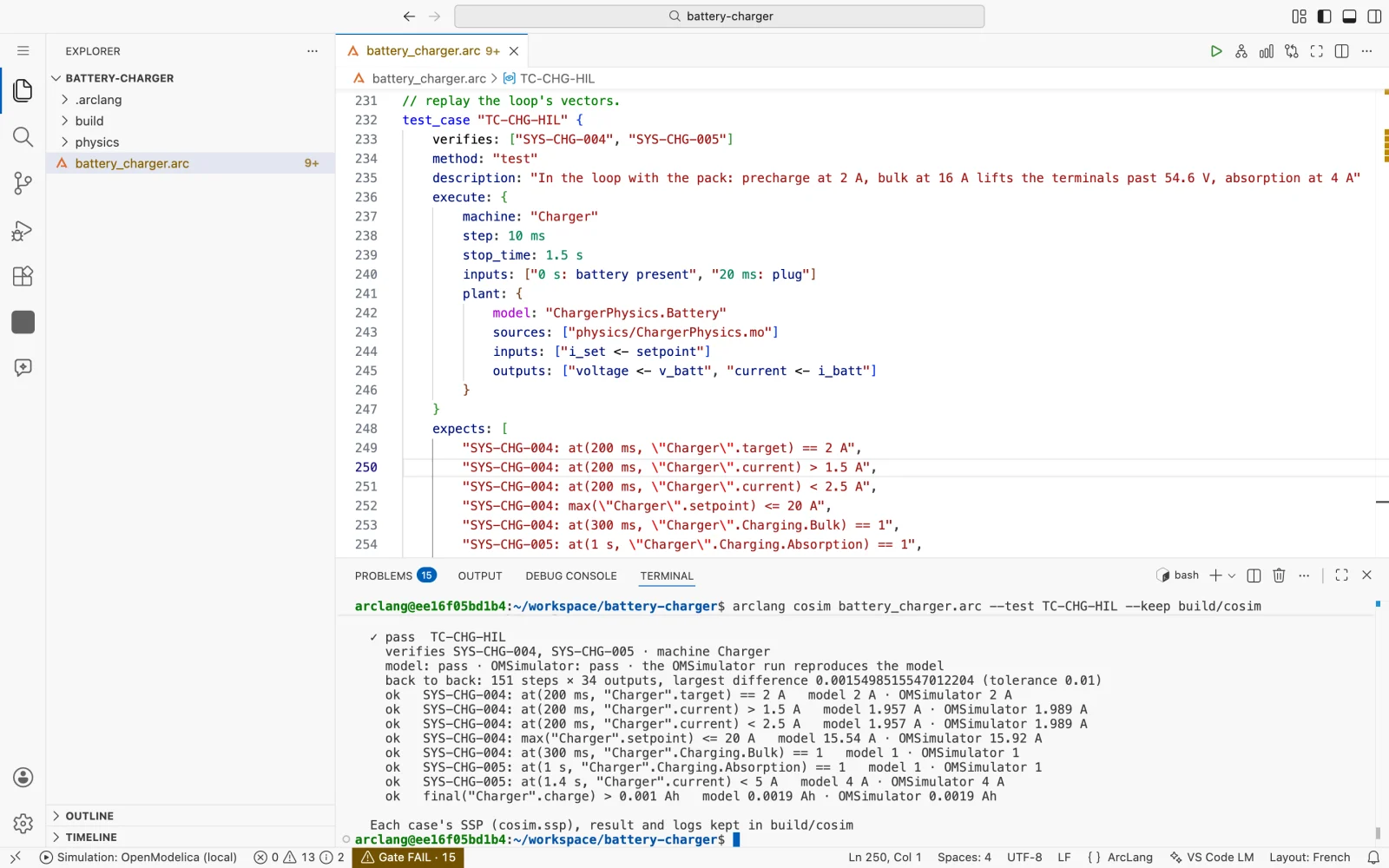
2. Run the case in OMSimulator. In the terminal:
arclang cosim battery_charger.arc --test TC-CHG-HIL --keep build/cosimThe first run takes a minute: OpenModelica builds the battery as an FMU. ArcLang compiles the controller as another FMU, puts both and the case's inputs in build/cosim/TC-CHG-HIL/cosim.ssp, and OMSimulator runs it.
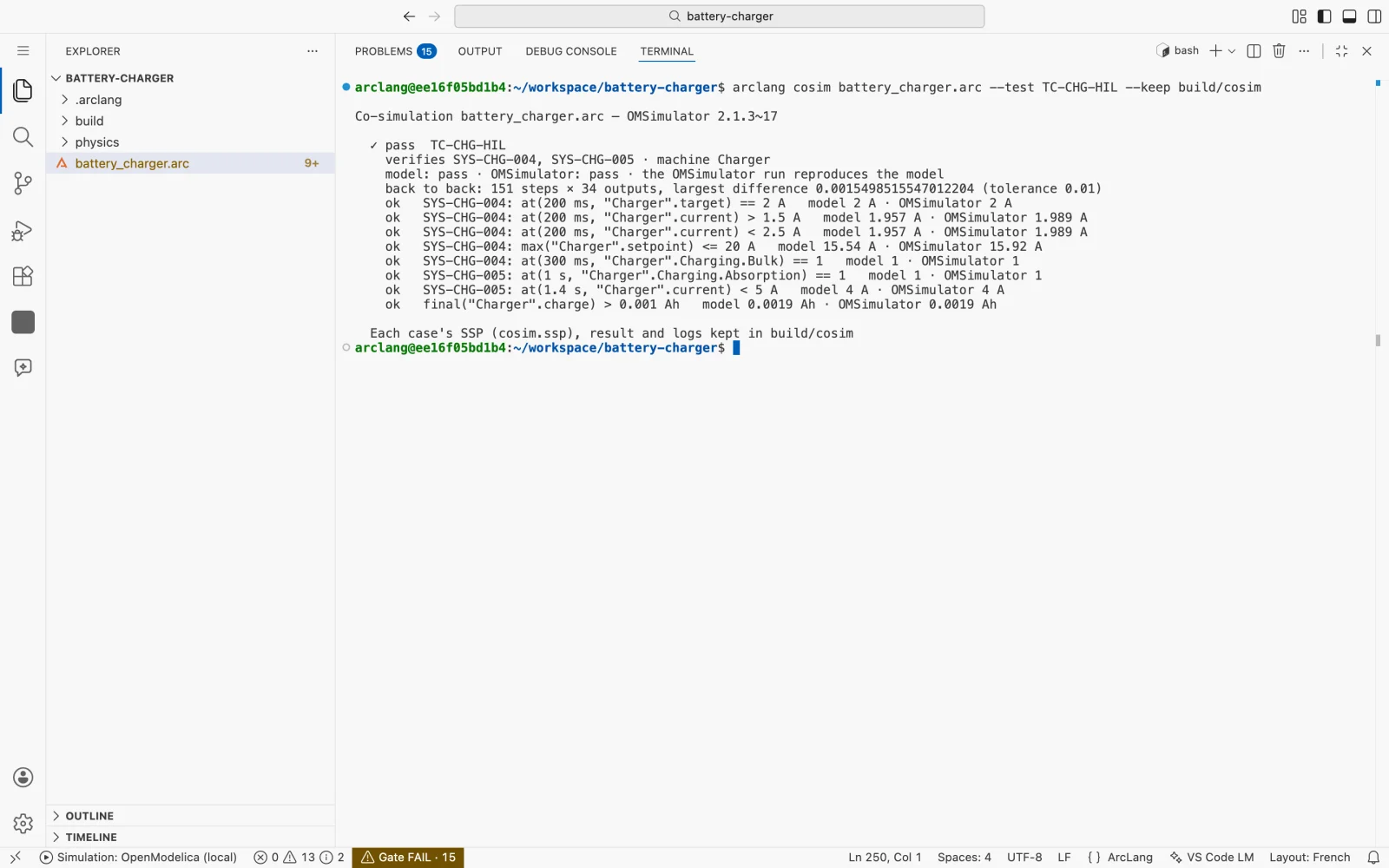
Read the verdict from the top:
model: pass · OMSimulator: pass: the expectations hold on the model's own run and on OMSimulator's;the OMSimulator run reproduces the model: every one of the 34 outputs, at every one of the 151 steps, is within the tolerance (0.01 here, because the battery's integrator runs under two masters);- one line per expectation, with its value on each run. The current at 200 ms is 1.957 A on the model and 1.989 A on OMSimulator: both are within 1.5 .. 2.5 A, and the difference is the period of delay explained in "How the run is judged".
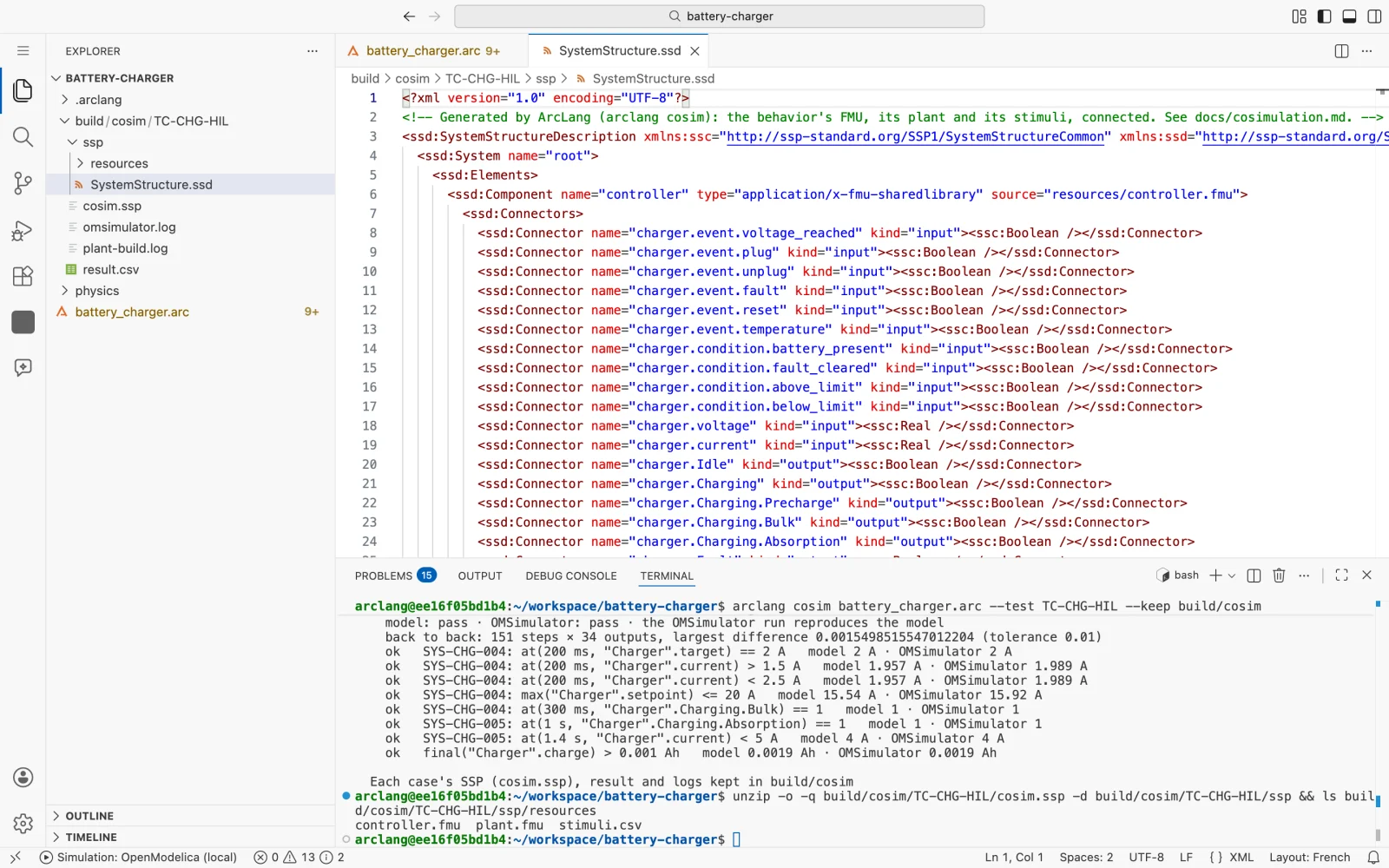
3. Look inside the SSP. cosim.ssp is a zip:
unzip -o -q build/cosim/TC-CHG-HIL/cosim.ssp -d build/cosim/TC-CHG-HIL/sspSystemStructure.ssd lists the three components (controller, plant, stimuli), every connector with its type, the connections and the master's step. resources/ holds the two FMUs and the table of inputs. Any SSP tool opens the package, including OMSimulator on its own: OMSimulator cosim.ssp --stopTime=1.5 --stepSize=0.01.
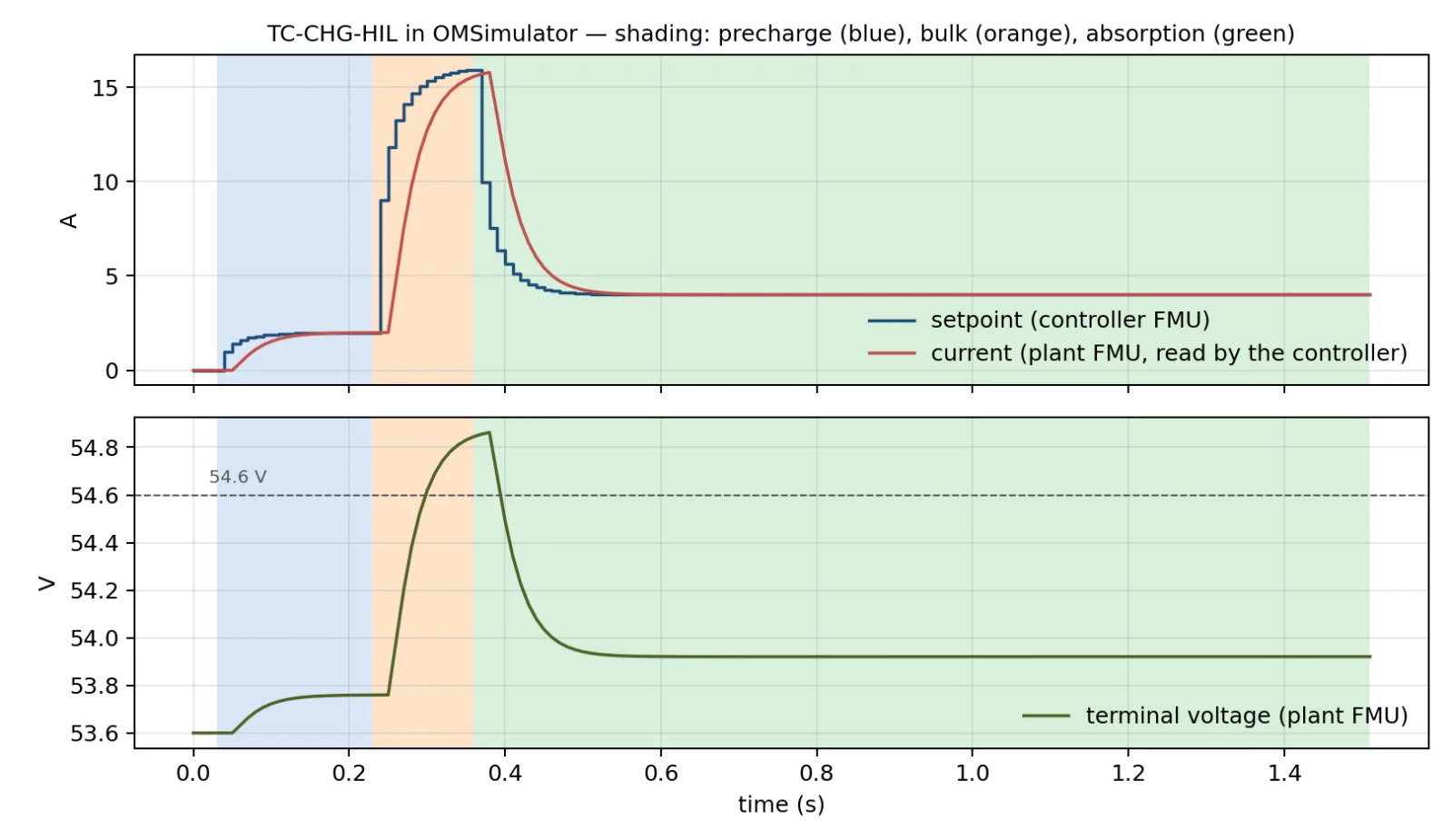
4. Plot the run. build/cosim/TC-CHG-HIL/result.csv is OMSimulator's result, one column per variable of every component. The charger precharges at 2 A, the setpoint jumps to bulk at 240 ms, the terminals pass 54.6 V, and absorption holds 4 A:
5. Run every case. arclang cosim battery_charger.arc runs the four cases. Three pass. TC-CHG-002 is skipped: it goes through an io_binding, and its channels are proven by arclang sil.
Exercises
Each exercise uses the charger, except the last one. The solutions were run in ArcLang Studio when this page was written.
Exercise 1. What runs, what does not. Run arclang cosim battery_charger.arc. Which cases pass, which is skipped, and why? What is the command's exit code?
Solution
TC-CHG-001, TC-CHG-003 and TC-CHG-HIL pass. TC-CHG-002 is skipped (– skip): it goes through the io_binding "Charger board", and the FMU exchanges the machine's variables, not its channels. A skipped case is not a failure, so the exit code is 0.
Exercise 2. Read the connections. In SystemStructure.ssd of TC-CHG-HIL, find the connections between controller and plant. Which connector of the plant does the controller drive, and which of the controller's connectors does the plant drive?
Solution
controller.charger.setpoint  ->  plant.i_set
plant.v_batt                 ->  controller.charger.voltage
plant.i_batt                 ->  controller.charger.current
They are the case's plant: block, inputs: ["i_set <- setpoint"] and outputs: ["voltage <- v_batt", "current <- i_batt"], written as SSP connections. Every other input of the controller is connected to the stimuli table.
Exercise 3. See the period of delay. In result.csv, compare the controller's setpoint and the plant's i_set at 230, 240 and 250 ms (take the first row of each instant). What do you see, and why?
Solution
t (s)   charger.setpoint   plant.i_set
0.23    1.99907            1.99867
0.24    8.99935            1.99907
0.25    11.79955           8.99935
The plant receives the setpoint one period after the controller computes it. OMSimulator steps both FMUs from the same instant, so over each period the plant is driven by what the controller gave at the start of it. That is why ArcLang compares this run with the model's loop delayed the same way.
Exercise 4. Make a requirement fail. In TC-CHG-HIL, change the expectation at(1.4 s, "Charger".current) < 5 A to < 3 A and run the case again. What is the verdict? Does OMSimulator still reproduce the model?
Solution
✗ FAIL  TC-CHG-HIL
  model: fail · OMSimulator: fail · the OMSimulator run reproduces the model
  FAIL SYS-CHG-005: at(1.4 s, "Charger".current) < 3 A   model 4 A (fails) · OMSimulator 4 A (fails)
The case fails, on both runs, and the two runs still agree. The co-simulation is not what is wrong: the requirement is, since absorption holds 4 A. The command exits with an error, as it would in CI. Put the expectation back.
Exercise 5. A value computed inside the FMU. Copy examples/automotive/speed-monitor and run arclang cosim speed_monitor.arc --test TC-SPD-001 --keep build/cosim. In its SystemStructure.ssd, what is the kind of the connector overspeed_warning.speed? Why is it not an input, although the machine declares in speed?
Solution
kind="output". The machine reads its speed from another machine, in speed: Real [km/h] from "Wheel speed filter".speed, and both machines are in the same FMU. The FMU computes the speed itself, so nobody outside may set it: it is an output, the value after each step. Only the filter's raw input comes from the table.
What a case becomes
For each case with execute: (Embedded C, "Test cases executed at fixed step"), ArcLang writes cosim.ssp:
| In the SSP | What it is |
|---|---|
resources/controller.fmu |
the behavior, export -f fmu, compiled with --cc (else $CC, else cc) |
resources/plant.fmu |
the case's plant:: a Modelica plant built by OpenModelica (FMI 2.0 CS, CVODE), or the fmu: it gives |
resources/stimuli.csv |
the case's inputs: as a table OMSimulator reads, one column per input of the FMU |
SystemStructure.ssd |
the three components, their connectors, the connections, the master's fixed step (the machine's period) and the stop time |
The table drives the controller's inputs that the plant does not drive. The plant's outputs drive the machine's in variables named in outputs:, and the machine's variables named in inputs: drive the plant. OMSimulator runs the package at the machine's period, and the result is read back at the end of each step.
A Modelica plant is wrapped (ArcLangCosimPlant) so that each wired variable is an FMU input or output in the machine's units: OMSimulator does not apply an SSP connection's linear transformation, so the wrapper converts to and from SI itself. A given FMU is taken as it is. Its wired variables must be inputs and outputs (an FMU's local variable cannot be connected), and the machine variables wired to them must be declared in SI units, because nothing converts along the connection.
How the run is judged
The case's expectations are judged on the OMSimulator run and on the model's own run. Both verdicts must agree, and the run must reproduce the model's trace, every output at every step, within a tolerance:
- without a plant: what OMSimulator's result can tell apart. It prints 12 significant digits, so the tolerance is 1e-9 of the largest value in the case, rounded up to a power of ten;
- with a plant: a hundred times the plant's tolerance (
1e-6by default), relative to the largest value. The same plant FMU's CVODE runs under both masters: each run is right to its tolerance locally, but their internal steps differ, most after a jump of an input. OpenModelica's FMU integrates at 1e-6 when it is asked for less (measured: the gap is the same at 1e-9), so atolerance:below 1e-6 does not tighten the comparison.
The plant gets the controller's outputs one period late. OMSimulator steps every FMU from the same instant (a Jacobi master): over [t_k, t_k+1] the plant is driven by what the controller gave at t_k, which is the step before. ArcLang's own loop steps the machine first, then the plant on the machine's new outputs. Neither is wrong, and the late one is how a digital controller behaves when its command goes out at the next tick. A case with a plant is therefore compared with the model's loop held the same way (plant::run_held). Its expectations are still judged on the model's own loop: a requirement that holds only without the delay shows as a disagreement between the two verdicts.
The outcome says OMSimulator 2.1.3; the behavior's FMU (…), plant … built by OpenModelica … in its tools.
Measured
On the examples, in the Studio image (arm64):
| Model | Case | Steps × outputs | Largest difference |
|---|---|---|---|
automotive/power-window |
TC-PW-001, TC-PW-002 | 16 × 21, 13 × 21 | 0 |
automotive/adaptive-cruise |
TC-ACC-SIL-001 | 101 × 6 | 0 |
energy/battery-charger |
TC-CHG-001, TC-CHG-003 | 61 × 34 | 5e-11 |
automotive/speed-monitor (data flow) |
TC-SPD-001 to 003 | up to 101 × 9 | 5e-10 |
energy/battery-charger, Modelica plant |
TC-CHG-HIL | 151 × 34 | 1.5e-3 (tolerance 1e-2) |
On TC-CHG-HIL, every expectation holds on both runs. That includes precharge at 2 A, bulk from 300 ms and absorption at 1 s, which prove SYS-CHG-004 and SYS-CHG-005. The largest differences come right after the setpoint jumps from 2 A to 9 A.
The cases that go through an io_binding are skipped (– skip): the FMU exchanges the machine's variables, not its channels, and arclang sil proves the channels.
Where OMSimulator comes from
- On this computer:
OMSimulatoron thePATH, or the program named byARCLANG_OMSIMULATOR. A Modelica plant also needsomc(modelica.md). - Otherwise the command runs in ArcLang Studio, which holds OMSimulator next to OpenModelica, as
pil,hdlandsocdo. SetARCLANG_EMBEDDED_DOCKER=offto never relay.
OMSimulator's FMI loader looks for an FMI 2.0 binary in linux64 on x86_64 Linux, and in linux32 on any other Linux processor (aarch64 included). On aarch64 Linux, each FMU put in the SSP therefore also gets its binaries, and the libraries beside them (OpenModelica's SUNDIALS), under binaries/linux32. The FMU export -f fmu writes is not changed.
A CSV table is interpolated linearly by OMSimulator, and its master's instants carry rounding (0.1 s is read at 0.0999…). The stimuli table therefore holds each step's value flat a quarter of a period on each side of its instant, and puts the ramps between instants, where the master never reads. An event is then read as exactly 1 or 0, never as 1e-15.
What is not done
- Cases through an
io_binding(see above). - Wires to the plant other than reals: a co-simulation wire carries a Real.
- A given plant FMU with its own units: the machine variables wired to it must be in SI.
- The verdict is not yet a rung of the realization ladder (Realization ladder).
- An FMI 3.0 export of the behavior.